
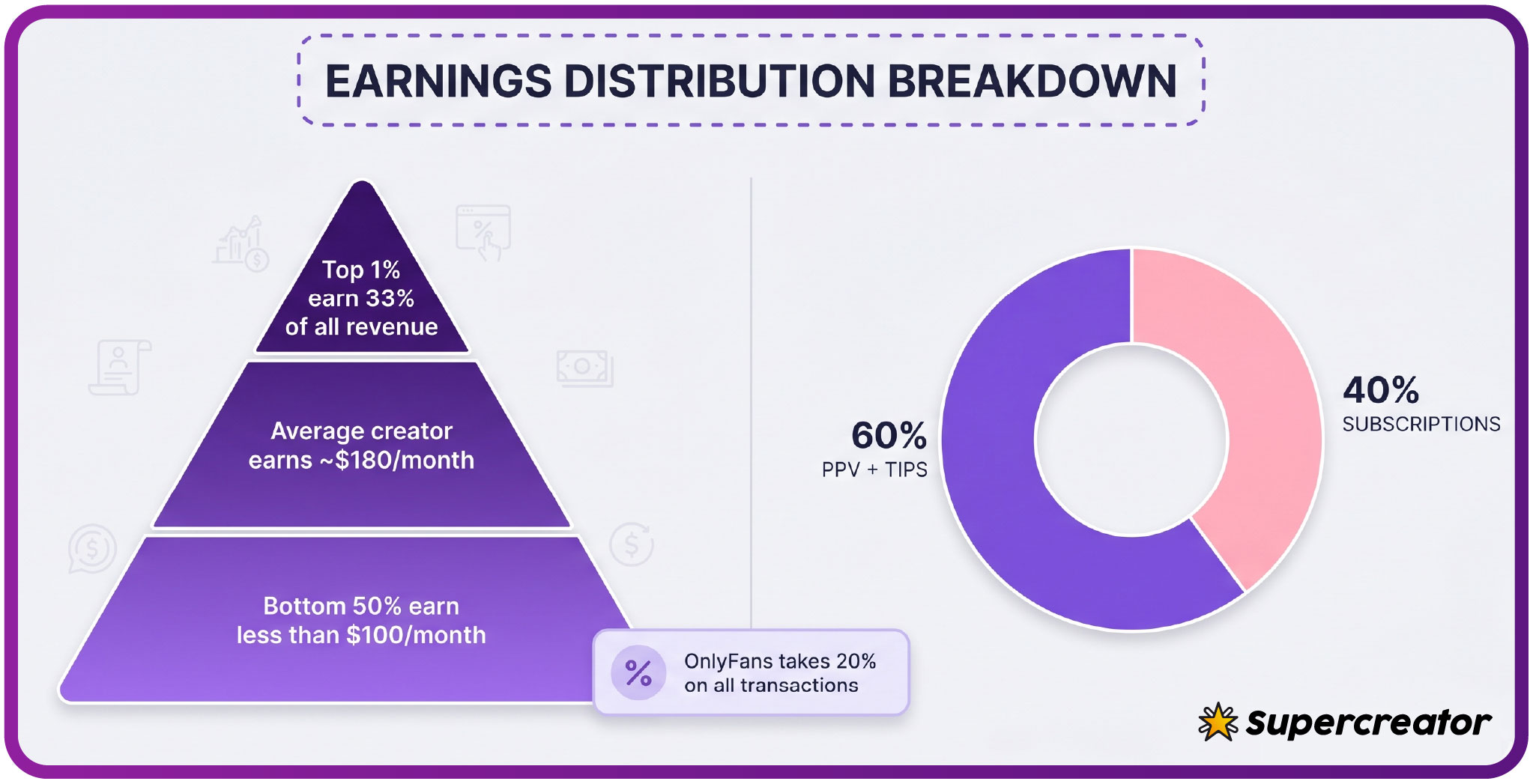
OnlyFans keeps 20 cents of every dollar you spend, no matter what you buy — subscription, tip, pay-per-view message, or custom order. That single fact explains almost every pricing decision a creator makes, and understanding it will stop you from being surprised when a $9.99 page still asks for extras.
This guide covers how the fee is structured, how it shapes the prices you see, why it pushes creators toward add-on income, how to read a page’s earning model before you subscribe, and what the cut cannot change regardless of how a creator prices their content.
Where the Fee Sits
The platform takes 20% of every transaction processed through its system and passes 80% to the creator. There is no tiered rate, no loyalty discount for high-earning creators, and no fee-free category. Every income stream is subject to the same split.
The concrete items that carry the fee are:
- Monthly subscription charges (including bundle deals at 3, 6, or 12 months)
- Pay-per-view messages, capped at $50 per message
- Tips, up to $100 in the first four months of an account and up to $200 after that
- Paid chat messages, which commonly run $3–$5 each
- Custom photo sets, typically $10–$30
- Custom video orders, typically $20–$50 for standard requests and $50–$100 for fully bespoke work
- Per-minute video purchases, typically priced at $5–$15 per minute
Nothing leaves that list. If money moves from your card to a creator’s balance, the platform already removed its fifth before the creator sees any of it.
How the Fee Shapes Prices
Because the creator always nets 80%, every price you see is already built around that loss. A creator who wants $8 in hand each month needs to charge $10. The table below shows how this plays out across the most common transaction types.
| Revenue source | What the creator keeps | What it means for you |
| $4.99 base subscription (platform minimum) | $3.99 | Even the cheapest paid page costs the creator almost a dollar in platform fees per subscriber each month |
| $9.99 mid-market subscription | $7.99 | Most pages in the $6–$10 band net under $8; extras are needed to meaningfully raise income |
| $50 PPV message (cap) | $40.00 | A single capped PPV earns the creator five months of income from a $9.99 sub; high-priced PPV is efficient for them |
| $100 tip (post-month-4 cap: $200) | $80–$160 | Tips scale well relative to subscriptions; creators who encourage tips are compensating for a low sub price |
| $75 custom video order | $60.00 | One custom covers nearly eight months of income from a $9.99 sub; customs are disproportionately valuable to creators |

Why the Fee Pushes Creators Toward Extras
Subscription income alone rarely sustains a page. The average creator earns roughly $150–$180 per month after the platform cut, which works out to around $1,800–$2,200 per year. About 70% of all creators stay under $200 per month in total earnings. These figures exist because subscriber counts are much smaller than most people assume: roughly 1–1.5% of a creator’s social-media followers actually convert to paying subscribers, so 10,000 followers produces around 100 paying subscribers and about $1,000 per month at a $10 price point.
With those margins, a creator charging $9.99 and carrying 80 subscribers nets around $639 per month before any extras. A single $50 PPV sent to half that list and accepted by 20 people adds $800 in one message. The arithmetic makes extras the logical priority, and the 20% fee on subscriptions makes that gap even wider.
Data from ranking sites, which tracks pricing and promotions across a large sample of pages, consistently shows that pages in the $4.99–$7.99 subscription band carry significantly more PPV activity than pages priced above $12. Low sub price and high extras volume are a deliberate pairing, not a coincidence.
Practical warning: If a page advertises a subscription price that looks too cheap to make sense — say, $3 for the first month — check the renewal rate before you subscribe. Promotional first months and trials can fall below the platform’s $4.99 base minimum, but the renewal always reverts to the full price. You are not locked in, but you will be charged the real rate on the next billing cycle unless you cancel first.
Subscription Income Against Extras
Not every page uses the same earning model. Understanding which model a page uses tells you what your actual spend is likely to be after the first charge.
| Model | What the creator relies on | What you experience |
| Subscription-first | Recurring monthly charges from a stable subscriber base | Full feed access is included; PPV and custom requests are optional, not frequent |
| Extras-first (low sub, high PPV) | PPV messages, tips, and custom orders | Sub price is low or free, but the feed has locked content and messages arrive with prices attached |
| Free page | Entirely PPV, tips, and customs; no subscription revenue | No entry cost, but almost nothing in the feed is unlocked without payment |
| Bundle-heavy | Multi-month prepayment at a discounted monthly rate (30–70% off) | Lower per-month cost if you commit long-term; creator gets a lump sum that survives churn |
What the Fee Does Not Change
The 20% cut is a constant. There are several things it has no effect on at all, and it is worth knowing what those are so you do not factor it into decisions where it is irrelevant.
- The subscription price you were charged when you first subscribed — creators cannot apply a price increase to existing subscribers
- Whether a page offers bundles at 3, 6, or 12 months; that is entirely the creator’s choice
- Whether a creator responds to messages or fulfills custom requests; the fee does not set any service standard
- Refund eligibility; the platform’s refund policy operates separately from the revenue split
- How often a creator posts or what they post; the cut is the same regardless of volume
- The price ceiling on subscriptions, which remains $49.99 regardless of platform cut
Reading a Page Through the Fee
Before subscribing, you can usually work out which earning model a page uses and what your likely total spend will be. Run through these steps in order.
- Check the subscription price against the $4.99–$49.99 range. If it is below $4.99, you are looking at a promotional rate — confirm the renewal price.
- Check whether the page is free or paid. A free page earns only from PPV, tips, and customs, so expect the feed to be a locked storefront.
- Look at how much of the preview feed is locked. High lock rates signal an extras-first model regardless of the subscription price.
- Check whether bundle options exist. A 3- or 6-month bundle at a reduced monthly rate indicates the creator wants committed subscribers rather than casual ones.
- Look at the PPV message frequency if the creator mentions it. Creators who openly advertise daily or weekly PPV are signaling that extras will be constant.
- Cross-reference the page’s listed price on BestOnlyFans to see whether a current promotion is running and what the standard renewal rate is.
Pages That Lean on Subscriptions
Some pages are genuinely built around subscription income and treat extras as secondary. If you want predictable spending, these are the traits to look for when browsing top rated onlyfans accounts.
- Subscription price in the $10–$20 range, reflecting a creator who needs revenue from the sub itself
- Most feed posts unlocked for subscribers without additional payment
- PPV messages sent occasionally rather than daily
- Long posting history showing consistent volume regardless of extras activity
- Bundle discounts offered at 3 or 6 months, encouraging longer commitments at a lower per-month rate
Pages That Lean on Extras
Pages built primarily on extras tend to share a recognizable set of signals. BestOnlyFans flags several of these traits in its price-tracking data, and spotting them early helps you budget accurately. If you are comparing this type of page against others, looking across curated lists of popular onlyfans accounts can show you how broadly these patterns repeat at scale.
- Subscription price at or near $4.99, or a free page
- Feed preview shows mostly locked posts
- Creator bio or pinned post mentions frequent PPV messages
- Custom order pricing is prominently listed
- Tip menus pinned to the profile with specific amounts for specific items
BestOnlyFans data shows that the extras-first model is far more common across the platform than most subscribers expect when they first join. Knowing this in advance means you can choose your pages with a realistic picture of total cost rather than just the headline subscription price.
FAQ
Does the 20% fee mean creators charge more than they otherwise would?
Yes, in most cases. Because a creator nets only $0.80 per $1.00 charged, anyone who wants a specific take-home amount must set their price 25% above that target — a creator who wants $8 must charge $10, and that calculation applies across every income type, which pushes prices upward across the board.
If a creator raises their subscription price, do I pay the new rate?
No. Existing subscribers keep the rate they signed up at; the higher price only applies to new subscribers who join after the increase takes effect, which means long-term subscribers often pay less than new ones on the same page.
Why are PPV messages capped at $50 if the creator only keeps $40?
The $50 cap is a platform limit on any single PPV message transaction, not a suggested price — most PPV messages are priced well below $50, and the cap exists to prevent abuse rather than to set a standard rate; creators can and do price individual messages anywhere from a few dollars up to that ceiling.
Does the platform fee apply differently during a promotional first month?
No. The 20% fee applies to whatever price is actually charged, including promotional or trial rates below $4.99 — the creator keeps 80% of a discounted price just as they keep 80% of the full renewal rate, so a deeply discounted first month earns them proportionally less even after the fee is factored in.